Showing posts with label Jacob Trowbridge. Show all posts

Monday, August 19, 2019

25 Surprising Fantasy Stats From 2018 That Could Help You In 2019
25 Surprising Fantasy Stats From 2018 That Could Help You In 2019

Josh Allen LeSean McCoy

That's a wrap on the 2018 football season, folks! Just because the season's over, that doesn't mean you should stop learning from it. Here are some surprising fantasy stats about the year that saw Pat Mahomes' breakout, Le'Veon Bell's holdout, and Derrick Henry's record-breaking resurgence. Use these nuggets of information to help secure a championship in 2019!

Note: The following stats are based on PPR formats.

1. Only 3 Top 10 QBs From 2017 Finished In The Top 10 This Year

What do Drew Brees, Russell Wilson, and Dak Prescott have in common? In case you missed the giant, bolded hint above, they're the only three quarterbacks who managed to finish inside the Top 10 at the quarterback position both of the last two seasons. And all three just barely managed the feat this year, finishing as QB8, QB9, and QB10 respectively.

2019 Impact: I wouldn't bet against Mahomes, Roethlisberger, Rodgers, Luck, or any of the top tier QBs from this season to repeat next year. But there are plenty of question marks in that group to consider over the offseason. Will any of them outside of Mahomes be considered "safe plays" going into next season? (Hint: Spoilers ahead...)

2. Drew Brees Finished As A QB1 For The 15th Straight Season

Did you know that if you rearrange the letters in Drew Brees' name it spells "consistently underrated"? (Okay, so that's obviously not true. But you do get the anagram Drew's Beer, which would be a solid name for the future Hall of Famer's microbrew business, should he choose that route after retirement.)

Brees has been by far the most consistent QB in fantasy football for well over a decade. I mentioned a version of this in last year's Fun Facts article, but it bears repeating: Brees has only fallen outside the Top 5 QBs once since 2005. Even more ridiculous? Since officially taking over from Doug Flutie in 2004, Brees has never fallen below QB12. Never.

2019 Impact: If Brees decides to keep playing next year -- he turned 40 in January -- he could once again be the safest QB pick on the board. Especially if he remains outside the Top 5 QBs in ADP.

3. Ryan Fitzpatrick Was A Top 5 QB On A Per Game Basis

Fitzmagic enjoyed by far the greatest per game numbers of his career, finishing as the QB5 on the year using that metric. And this includes the multiple games where he played basically one half, either getting benched for Jameis Winston or getting put on the field because Winston was benched.

2019 Impact: Don't be surprised if Fitzpatrick somehow finds himself onto the field again in 2019. He's a free agent, but the Bucs could hang onto him as a "Break In Case of Emergency" option with a proven track record. What Fitzpatrick was able to do in limited starts as a backup shouldn't go unnoticed, and he could once again be a viable streaming option next year.

4. Nick Foles Was QB27 On A Per Game Basis

And then there's this guy. The city of Philadelphia -- and fans of football magic in general -- rallied behind Nick Foles because he's a lovable underdog, in the mold of Rocky Balboa or Charlie Day. Pundits will spend all offseason talking about the heart he showed late in the season while guiding the Eagles to another unlikely postseason run. They'll fawn over possible landing spots for the backup QB with the touch of gold. And yet...

In his 5 regular season starts, Foles put up a paltry 15.0 fantasy points per game. That's worse than Josh Allen, Andy Dalton, Joe Flacco, Eli Manning, and Matt Barkley performed on a per game basis. Flash back to 2017, and Foles' 3 regular season starts netted him a cool 11.2 fantasy points per game. That number was below Jay Cutler, Jacoby Brissett, Blaine Gabbert, Trevor Siemian, Brock Osweiler, and was tied with Brett Hundley.

2019 Impact: If Foles does end up getting traded into a starting spot, you may not want any part of him for fantasy purposes. If you have him on your dynasty squad, now would be a good time to sell.

5. Lamar Jackson Would Have Finished As A Top 30 Rusher, Despite Starting Only 7 Games

Rushing for 697 yards on the season while starting just 7 regular season games is an impressive feat. Doing so as a quarterback is straight up bonkers. Jackson averaged 79 yards on the ground in those 7 starts, and added 4 rushing touchdowns for good measure. Using those 7 games, he was on pace for 1,257 yards rushing over a full season.

I mean...WHAT!?

Not only did Baltimore's rookie quarterback out-rush all others at his position, he put up more yards on the ground than Mark Ingram, Leonard Fournette, Isaiah Crowell, Kerryon Johnson, Dalvin Cook, Carlos Hyde, Kenyan Drake, Dion Lewis, LeSean McCoy, and Alex Collins. These people, you might have noticed, are all actual running backs.

2019 Impact: It's hard to get a better floor than what Jackson provided in 2018. If the torch is finally and officially passed from Joe Flacco, Jackson could be one of the safest plays at the position due solely to his usage in the run game.

Want More Personalized Advice? Schedule A Live Consultation With A Fantasy Expert!

6. Josh Allen Was The Leading Rusher In Buffalo

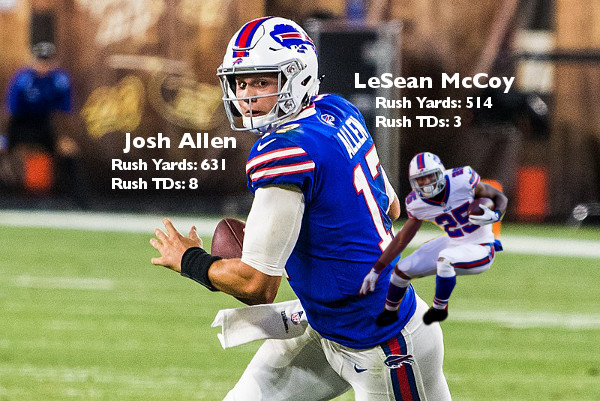
Does that sound impressive? Or...sad? Regardless, rookie QB Josh Allen was the leading rusher on the Bills squad by a wide margin. Allen put up a solid 631 yards with his legs, including 8 rushing touchdowns. Meanwhile, LeSean McCoy rushed for just 514 yards and 3 touchdowns. 

If that's not strange and depressing enough, McCoy played in 2 more games than Allen. Want more? Okay! Allen finished the year with 3 games of at least 99 yards rushing. McCoy did that just once. Basically, the 30-year-old running back hit a brick wall, and the spry 22-year-old QB took it upon himself to carry his team up and over it.

2019 Impact: LeSean McCoy might finally be done. He notched a career low in nearly every major category and looked like he was running with molasses in his shoes. But Allen deserves some credit here as well, and he could carry a similar floor to Lamar Jackson next year.

7. Multiple Quarterbacks Rushed For As Many Touchdowns As Their Lead Running Back

Welp, might as well beat the living hell out of this dead horse while we're standing around it. 2018 was a quiet resurgence for rushing quarterbacks, as evidenced by the fact that 3 different QBs found the end zone just as frequently as their "star" running backs.

As previously mentioned, Josh Allen put up 5 more TDs on the ground than LeSean McCoy. Elsewhere, Dak Prescott equaled Ezekiel Elliott's 6 rushing touchdowns, and Deshaun Watson matched Lamar Miller's 5 end zone scampers. Considering that these are all considered "workhorse" running backs, that's a mighty interesting stat.

2019 Impact: Running quarterbacks have always been coveted in fantasy football, but those that can also find the end zone deserve special attention. All three QBs mentioned above have the versatility to keep fantasy owners happy moving forward.

8. One Third Of The Top 12 Running Backs Came From An NFL Team With A Losing Record

The notion that you want/need your fantasy running backs to come from "winning" teams was severely tested this year. Saquon Barkley, Christian McCaffrey, David Johnson, and Joe Mixon all came from teams with a losing record, and all of them put up RB1 numbers in PPR formats this year. Notably, Phillip Lindsay and Kenyan Drake just barely missed the cut, finishing as the RB13 and RB14, respectively. They both came from losing teams, as well.

The key to running back success in fantasy football has always been volume. So long as your guy is guaranteed 15+ touches in a game, he should be fine even if he's not a standout talent. But typically your guy is only going to get that volume if his team is winning games OR if he's also a talented pass-catcher.

2019 Impact: Every player listed in that Top 12 had at least 50 targets on the season, with 40+ receptions. That allows them to make hay for your fantasy squad even if the team they play for is constantly getting crushed. (Unless it's Theo Riddick, who only catches short passes and does little to no actual running.)

9. Saquon Barkley Led All Rookies...In Receptions

Despite playing on an offense that was overly-accustomed to playing from behind this season, Saquon Barkley still managed to excel as a rookie running back. In fact, it was because the offense was constantly trailing that Barkley needed do so much damage through the air, racking up 91 receptions for 721 yards.

To put that in context, those 721 yards helped him push past 2,000 total yards on the year. Those 91 receptions broke Reggie Bush's reception total for rookie running backs. Not too shabby. 

2019 Impact: It's pretty much a guarantee that Barkley will fly off the board as the No. 1 running back next year. And considering what he did in the current Giants offense, it would seem there's nowhere to go but up. Barkley > Gurley in PPR formats? It certainly seems so.

10. David Johnson Finished As A Top 10 Running Back

If you drafted David Johnson -- likely with one of the first five picks of your draft -- you probably don't feel like you got your money's worth from the Arizona running back. Regardless of Johnson's early failings, he managed to scrape together a below-the-radar Top 10 finish. And he did this despite finishing as a weekly Top 12 RB just twice.

Johnson finished with more than 20 fantasy points in only three games this year. Back in 2016, his last healthy season, Johnson racked up 11 such games. You didn't get 2016 production out of David Johnson this year, but the topsy-turvy nature of the running back landscape still netted him the No. 9 spot at the end of the year.

2019 Impact: Johnson was stuck in an uninspired offense with a rookie quarterback still learning the ropes, but he received the 3rd-most rushing attempts of any running back, which helped balance things out. Even if DJ once again gets nothing but runs straight up the middle next year, he's still a safe option who may be had for a steep discount in next year's draft.

Get a head start on next season with a Fantasy Knuckleheads membership!

11. Nick Chubb Nearly Cracked 1,000 Yards Rushing Despite Starting Just 9 Games

With all the talk of Saquon Barkley's jaw-dropping rookie year, what gets overlooked is just how incredibly Browns' running back and fellow rookie Nick Chubb performed this year.

While Chubb was technically 4 yards shy of a cool thousand, the fact that he put up that number while playing second fiddle to Carlos Hyde for the first half of the season is mind-boggling. If he'd had a full season as the lead dog -- perhaps if Cleveland brass had moved on from Hue Jackson on a more reasonable timeline -- Chubb would be in contention for Rookie of the Year honors. Even still, an RB17 finish with only half of a season to work with deserves more kudos.

2019 Impact: Chubb is the real deal, and I fully expect him to be coveted as an RB1 next year. If he falls to the mid-or-low 2nd round, Chubb will be an absolute steal.

12. Derrick Henry Was The No. 1 Running Back During The Fantasy Playoffs

Like a hibernating bear roused awake by the promise of Charmin Ultra Soft toilet paper (those commercials just get me), it took Derrick Henry a good long time to finally reach his full potential. But then he steamrolled his way through the competition. 

Though pretty well useless for your fantasy squad for the first 13 weeks of the season, if you somehow had the foresight (or sheer stubbornness) to keep him on your roster, you were served one of the finest fantasy playoff performances of the last decade. Henry averaged an unreal 31.4 fantasy points per game when it counted the most.

2019 Impact: Henry's short career paints him as a fits-and-spurts sort of running back, incapable of providing consistent fantasy value. Recency bias will skyrocket his perceived value, so I'd be selling him in dynasty. However, if he makes it to the late 4th round in redraft leagues, I'd be willing to give him a shot in the hopes that Tennessee's new offensive coordinator can finally crack the code for making Henry a more consistent player.

13. Ezekiel Elliott Was The Only Running Back To Notch 300 Carries In 2018

300+ carries (not total touches) is a big workload for a running back these days, which is why the old workhorse RB model has largely died off. Ezekiel Elliott appears to be the last of this breed. And to his credit, he seems to handle it pretty well, as he averaged 4.7 yards per carry this season.

Zeke was also the only back to carry the ball 300+ times in 2016, when he averaged 5.1 YPC. In 2017 -- when he served his 6-game suspension -- Elliott toted it for 242 attempts over 10 games, which put him on a full-season pace of 387. He averaged a career low 4.1 YPC that year.

2019 Impact: There's reason to be weary of the strain Zeke put on his body this year, and all the years before. Historically, players who have average at least 300 rushing attempts per season hit a wall sooner than later. But Dallas is committed to the run game, and it's likely Jason Garrett feeds Zeke until the wheels fall off. He's a safe bet for another 300 carries (plus an increased pass-catching workload) and a high-end RB1 finish in 2019, so long as his body can hold up.

14. "Replacement" Running Backs Accounted For 27% Of Top 12 Finishes

"Next man up" is a tired phrase in football, thought it applied pretty heavily to this year's NFL backfields. There were plenty of injuries, trades, and off-field issues that kept supposed starters on the sidelines for huge chunks this year. Players like James Conner, Phillip Lindsay, T.J. Yeldon, Giovani Bernard, Damien Williams, Gus Edwards, and C.J. Anderson all stepped into lead roles and provided immediate value in fantasy.

Excluding Week 17 -- when oodles of starters typically rest for various reasons -- there were 52 separate instances where obvious backups (i.e. not the 1B in backfield committees) put up RB1 level numbers. That means 27% of the Top 12 finishes came from backup or fill-in running backs. For reference, David Johnson finished in the Top 12 just 12% of the time. Oh, and there were also 3 times where a backup finished as THE top back in fantasy that week. 

2019 Impact: I'm not going to say running backs don't matter, but it's very clear that opportunity matters just as much as talent in fantasy football. It doesn't matter where they were on the depth chart entering the season, if a running back gets guaranteed touches in a respectable offense, they deserve a spot in your lineup. It's obviously difficult to project which backups will eventually see the field, but once they get there, grab onto them and don't let go.

15. 81% Of Players Who Finished In The Top 12 Were Already There By Season's Midpoint

Fantasy analysts like to say "You can't win your league in the draft." And while that's technically true, there was a lot more consistency in the upper echelons at each position than we're used to. Of the players who finished the season in the Top 12 at their position, 39 of those 48 players were already sitting in the Top 12 after Week 8.

Yes, a handful of guys shot up the ranks later on -- for example, Dak Prescott was QB23 after Week 8, but finished the year as QB9 thanks in large part to Amari Cooper's arrival -- but in general, the top dogs held steady from start to finish.

2019 Impact: Very few top tier players hit a wall late in the season. It's a bit of an ambiguous stat, but dammit I thought it was incredibly interesting! Maybe it means fast starts aren't to be discredited by fantasy owners constantly looking for something "better" around the next corner? 

16. Three Different Rams Receivers Finished Inside The Top 20 On A Per Game Basis

During the offseason, there was plenty of discussion about which Rams wide receiver you could trust, if any. General consensus had Brandin Cooks, Cooper Kupp, and Robert Woods all outside the Top 20 ADP for receivers, with Kupp outside the Top 30, and Woods falling all the way outside the Top 40.

All three notched at least 16.2 points per game, enough for Top 20 finishes all-around using that metric. It goes to show that truly prolific offenses can sustain multiple first-rate receiving options, and few have proven that quite like Sean McVay's group this year.

2019 Impact: Unless the Rams trade for an elite tight end (they won't), you can expect more of the same next year. In redraft, I'm taking whichever receiver falls the furthest. 

17. Robby Anderson Was The WR2 During Fantasy Playoffs

After heating up down the stretch in 2017, Anderson was a ghost for the majority of his third season. Whether it was due to the quarterback change, his off-field issues, or simply the pains of being a New York Jet, Anderson was not a reliable fantasy asset for the first 13 weeks of football. In fact, he put up 50 yards or more just once during that stretch.

But Anderson punched the ignition switch HARD come Week 14, averaging 10 targets, 7 receptions, and 129 yards per game during the fantasy playoffs. He also scored a touchdown in each of those three outings. Only DeAndre Hopkins finished better than Anderson during your league's most crucial batch of games.

2019 Impact: Once continuity comes to the Jets' QB spot, Anderson should become less frustrating on a week-to-week basis. There's no reason he couldn't finish as at least a WR2 next year so long as Sam Darnold keeps progressing. Keep in mind, however, that Quincy Enunwa sat out weeks 15 and 16, when Anderson did most of his damage. There are still some lingering questions about how big of a role the lanky receiver can actually have in the Jets' offense.

18. Julio Jones Has 5 Straight Seasons With At Least 1,400 Yards

No other player in NFL history has hit that mark, with the closest being former Colts' great Marvin Harrison, who had 4 such consecutive seasons. Julio remains a yardage machine, but the fact that he finally broke his touchdown curse is what made him such a strong fantasy receiver this year.

Five straight 1,400-yard seasons is a ridiculous feat, no matter how few touchdowns it results in. Julio finished WR6, WR2, WR6, WR7, and WR4 during that span, end zone catches be damned.

2019 Impact: There's no reason Julio Jones shouldn't be drafted as a Top 5 receiver again next year. With Antonio Brown's status as a Steeler in limbo, Jones could now be considered the 2nd-safest WR off the board next year, just behind DeAndre Hopkins.

19. Davante Adams Scored At Least 15 PPR Points In Every Game He Played

The Packers' disastrous offensive play didn't stop the team's No. 1 receiver from getting his in 2018. Adams hit 15 points or more in every single game he stepped onto the field for, which is how he ended up the WR1 on a per game basis this season.

Including 2017, Adams has scored at least 15 points in 23 out of the 29 games he's played. The fifth-year wideout has been one of -- if not THE -- most consistent receivers in fantasy football for these past two seasons.

2019 Impact: There's at least an argument to be made for Davante Adams being the first receiver off the board in drafts next year. Of course, with Green Bay undergoing significant changes to the coaching regime, it's uncertain how they'll utilize Aaron Rodgers' current go-to target.

20. Mike Williams Scored A Touchdown On 23% Of His Receptions

Nearly 1 out of every 4 passes caught by Mike Williams resulted in a touchdown. That kind of touchdown efficiency is almost unheard of. It makes sense when you realize that 21% of Williams' targets came inside the red zone, and 6 of his 10 touchdowns came from within the 10-yard line. But still...holy cannoli.

A few other players had even more impressive touchdown-to-reception ratios -- including John Ross (33%) and Jaron Brown (36%) -- but neither of them had even 25 catches on the season. 

2019 Impact: Touchdown regression is coming for Mike Williams. The Chargers were without Hunter Henry, who is bound to eat into some of Williams' red zone work. That's not to say Williams can't be productive next year, but he'll likely need more than the meager 66 targets he received in 2018 to do so.

21. James Develin Scored A Touchdown On 67% Of His Rushing Attempts

Yeah. You read that right. 2 out of every 3 times New England fullback James Develin ran the ball, he scored a touchdown. Granted, he only ran the ball 6 times all season. And all 6 of those rushes came within the 5-yard line. So there's that.

2019 Impact: It's the Patriots. Develin could be New England's leading rusher next year or he could be cut from the team this offseason. Neither move would surprise me. I can't see him as a viable draft option in 2019. Still an impressive stat, though.

22. Three Rookie Tight Ends Cracked The Top 20

This may not seem like a big deal at first glance, but it hasn't happened since 2010 when Aaron Hernandez, Rob Gronkowski, and Jermaine Gresham accomplished the feat. This year it was Chris Herndon, Mark Andrews, and Dallas Goedert challenging the notion that rookie tight ends don't produce out of the gate.

Now, I know none of those names really jump off the page as "fantasy studs." Because let's face it, their presence in the Top 20 has less to do with their individual output than it does the complete dearth of relevant tight ends in 2018.

2019 Impact: Keep an eye on all three of the names listed above, as it's possible they all take a sophomore jump in 2019. That said, much is in-flux with the Jets, Ravens, and Eagles, so I wouldn't consider any of them "must drafts" next year. I also don't believe their relative production this season belays a trend in regards to upcoming rookie tight ends. Don't overvalue the incoming TE draft class.

23. Three Tight Ends Drafted In The Top 5 Finished Outside The Top 10

Oof. What a disappointing season for the usually-dominant tight ends. Most egregious, of course, is Rob Gronkowski. No one could have predicted that a healthy-ish Gronk would make just 5 appearances inside the Top 15 this season. His recorded the 3rd-lowest targets per game, 2nd-lowest yards per game, and absolute lowest touchdowns per game of his career. But Gronk wasn't the only disappointment.

Jimmy Graham and Greg Olsen, with ADPs of TE4 and TE5 respectively, finished as the TE12 and TE25 on the season. Granted, Olsen was rarely healthy, but even when he was, it was clear Christian McCaffrey was Cam Newton's new favorite mid-field target. As for Jimmy Graham? Apparently the Green Bay curse continues for tight ends.

2019 Impact: Gronk might very well retire for real this offseason, but if he comes back for one more season, I'm not drafting him unless he falls to the 5th round. If Graham sticks around Green Bay, he'll fall off my draft board entirely. Olsen will likely make the transition to the commentator booth, but he's a big DO NOT DRAFT for me if he plays.

24. Only 4 Top 10 Defenses From 2017 Finished Top 10 In 2018

The Jaguars may have been the top fantasy defense last year, but they fell outside the top half this season. The Eagles were a Top 3 defense in 2017, but didn't crack the Top 15 this time around. The Chargers, Lions, Panthers, and Chiefs all dropped off a cliff as well. 

Meanwhile, the Texans rose from the ashes, jumping from #25 in 2017 to #3 in 2018. Similarly, the Colts improved by 12 spots to crack the Top 10 this year.

2019 Impact: Think about this next year when you're on the board in Round 8 and Chicago's D/ST is sitting there, taunting you. Sure, maybe Chicago will dominate fantasy scoreboards again in 2019. But how early are you willing to roll those dice?

25. Seven Top 10 Kickers From 2017 Got There Again In 2018

Just when I was all ready to pen my yearly reminder to fantasy football owners everywhere that KICKERS CANNOT BE TRUSTED, I stumbled across this statistic. I am both humbled and exasperated that we've finally seen some year-to-year consistency at the position. 

Sidenote: #10 from last year, Kai Forbath, wasn't the starting kicker on an NFL squad at the start of the year, so he wasn't being drafted in your fantasy league. So really, this could have been an even more consistent year for kickers. Woof.

2019 Impact: If you're looking for kicker impact, you're still doing this wrong. But hey, maybe it's not a bad idea to take a Top 10 guy from 2018 in next year's draft if he's still there in the last round.


Thank you for trusting Fantasy Knuckleheads to guide you through the 2018 fantasy football season. We're working on ways to provide even more content and advice for the 2019 season, so stay tuned!

Fantasy Knuckleheads


from Fantasy Knuckleheads https://ift.tt/2KJeEuf
via IFTTT

Sunday, July 21, 2019

Robby Anderson Can Be This Year’s Breakout Wide Receiver

Robby Anderson Can Be This Year’s Breakout Wide Receiver

In fantasy football, we're always on the lookout for the next top prospects. That's how you stay ahead of the curve and on top of your teammates. (Yeah, I heard it. And I stand by it.) It's not always an easy task, especially when it comes to wide receivers. More than any other position in fantasy football, receivers require the exact right combination of raw talent, opportunity, and chemistry with their quarterback to be elite.

And while we've seen flashes of that ability from Robby Anderson, he has yet to put it all together over the course of a full season. With the way things are shaping up for the 4th-year wideout, though, there's a very real chance we could be talking about Anderson as fantasy's next breakout star come the end of the 2019 season.

2018 Finish: WR39

His ADP in PPR formats is 7.02, and he's the 31st wide receiver being taken off the board. Anderson is currently being drafted behind the likes of Jarvis Landry, Mike Williams, Alshon Jeffery, and Dante Pettis. And look, I get it. He finished the season as WR39. That's very not great.

But as I noted in my 25 Surprising Stats From 2018 article Anderson was the WR2 during your fantasy playoffs, behind only DeAndre Hopkins in PPR formats. (Anderson was the WR1 in standard leagues, though I beg you all to stop playing in that abominable format.)

Those top tier numbers happen to coincide with Anderson's highest snap counts of the year by far. He averaged 94.8% of snaps in that stretch, but just 71.2% the rest of the year. He also saw significant upticks in his red zone targets during those last games. If the new coaching staff has any sense, they'll look at those numbers and understand the value of keeping Anderson on the field and getting him the ball.

Want Personalized Draft Advice? Schedule A Live Consultation With A Fantasy Expert!

The QB Connection

If you're not a fan of such small sample sizes, let's look through a wider lens. Things looked much brighter for Robby Anderson, surprisingly, when rookie quarterback Sam Darnold was on the field. Looking only at his games playing with Darnold under center, Anderson was on pace for 109 targets, 58 receptions, 881 yards, and 7 touchdowns. That would've been good for 188.1 PPR points and put him at WR25 on the season. That's a pretty respectable finish playing with a rookie quarterback.

Overall quarterback health has really hurt Anderson's consistency. He hasn't had a chance to develop a rapport with a QB for more than a handful of games before having asked to slum it with a replacement. But in the last 2 years, when he's actually played with the designated starting QB, he's been on pace for full-season stats of 62 catches, 1023 yards, and 9 touchdowns. That would've been good for WR18 last year. Now we're cooking.

If Anderson can finally get a connection going with Darnold -- and Darnold can remain healthy -- there's no reason to think those numbers can't grow.

Is Adam Gase A Coaching Upgrade Or Downgrade?

Look, we all know Adam Gase's history as an "offensive juggernaut" is almost exclusively related to his years with Peyton Manning. In 2 of his 3 years as the Dolphins' head coach, his offenses ranked dead last in number of plays run. And in his one season as offensive coordinator for the Bears, his offense ranked just 25th in passing plays. For reference, they finished 8th the season prior.

But hey, I'm supposed to be selling you on this guy, right? So let's talk positives. In that same season with the Bears, Alshon Jeffery was on pace for 167 tar, 96 rec, 1435 yards, 7 TDs. In those 3 seasons with the Dolphins, he twice had a top 15 fantasy receiver. Yes, it was slot receiver Jarvis Landry, but that was primarily a function of his lackluster quarterback and using his best offensive weapon. Anderson is that guy in New York.

Meanwhile, with the Jets, Todd Bowles' offenses have ranked 24th, 25th, and 22nd in passing attempts. So, at worst, we're really talking a lateral move with Gase.

Also, the Dolphins did finish 4th in passing plays in 2017, so we at least know Gase is possible of leading a pass-heavy offense. Besides, as the deep ball, big play threat, Anderson is perhaps the most immune to Gase's offensive fluctuations. He proved that under Bowles. He doesn't require massive target numbers to make waves in your lineup.

And as luck would have it, Anderson may be on the cusp of diversifying his role and becoming more than a one-trick pony. Gase said he wants to "create variety in his routes" and get him involved "underneath, intermediate or down the field." If that's more than the usual coachspeak, fantasy investors should be in for a wild ride with Anderson. Route diversity is critical to becoming a top tier fantasy receiver.

Sign up for a Fantasy Knuckleheads membership and get on the fast track to a fantasy championship!

Upgrades Around Him Can Bolster His Production

Le'Veon Bell may not see the kind of production fantasy owners are used to, but he'll definitely be a valuable asset for the Jets overall. And most importantly for our purposes here, he'll open the offense up and take away coverage from Anderson. Even if he's not used as a true workhorse, as Gase has suggested.

The same could be said -- to a lesser degree, of course -- about Jamison Crowder, who gives the Jets a firm slot presence. Having three healthy, versatile receivers could actually benefit Anderson, who's excited to face fewer double coverages with the bolstered offense. It's a valid point, and hopefully one that can be realized in 2019.

The Jets didn't added some pieces to their abysmal O-line to help keep Darnold upright, drafting OT Chuma Edoga in the 3rd round of the draft and, more importantly trading for former Pro Bowl guard Kelechi Osemele. They also drafted a pretty stellar blocking tight end in Trevon Wesco, though it's hard to predict how NFL ready he'll be. It's also worth noting the O-line was decimated by injuries last season, so if the group can actually stay healthy, it would be nearly impossible for them to be as bad as they were in 2018.

That's...something, right?

Robby Anderson's 2019 Projection

For the sake of argument, let's assume Anderson is the Jets' top receiver again this year, which isn't exactly a stretch. If we use Gase's 4-year average of 514 passes per season, and grant Anderson the average target share of Gase's No 1 receivers over that same span (26.2%), his career averages in yards per reception and catch percentage would give him 142 targets, 77 receptions, and 1132 yards.

If Sam Darnold's passing touchdowns increase from a paltry 17 to the league average 27, Anderson's red zone numbers should make 7-9 touchdowns an easily achievable mark.

Assuming the low end of his TD projection, this would all put Anderson at 232.2 fantasy points, which would've made him the WR15 in last year's final rankings. Give him the 9 TDs he's been on pace for when playing with the same starting QB from week to week, and that bumps up to 244.2 points and makes him WR13.

Do I think that production's a given? No, of course not. There are plenty of variables at play here, and a handful of things need to go right for Anderson to crack that high-end WR2 barrier. But do I think it's very much within the realm of reasonable outcomes? You bet I do. And for a healthy receiver currently going in the 7th round, you can't ask for much more than that. Sign me up for Robby Anderson as this year's breakout wide receiver.

Check out Jake Trowbridge's new podcast, Drinking & Talking Fantasy Football!

Fantasy Knuckleheads


from Fantasy Knuckleheads https://ift.tt/2JGMO1c
via IFTTT

Tuesday, June 25, 2019

Corey Davis Is The Vegetable Water Of Wide Receivers

Corey Davis Is The Vegetable Water Of Wide Receivers

To this point in his career, Corey Davis has been the cucumber water of wide receiver prospects. You bought him because he looked fancy and, dammit, you deserve to treat yourself to a quality wide receiver now and again. But a couple of sips in, you realize you just paid a bunch of money to drink regular tap water with vegetables floating in it. That's what Corey Davis has been so far in his career: Tepid vegetable water.

The question is whether Corey Davis will ever become more than that. Can he even rise up to the level of, say, sparkling pomegranate water? Or, to abandon this poorly-constructed water metaphor, can he rise up to the WR1-level of production so many thought possible back in 2017?

2018 Finish: WR28

In his sophomore season, Corey Davis put up some very respectable stats: 112 targets, 65 receptions, 891 yards, and 4 touchdowns. On a per game basis, he fell to WR38, but his overall finish is perfectly fine for a player that was generally drafted in or around the 6th round. But the fantasy community never expected Davis to be just "fine" for their teams. They wanted him to be a superstar.

We're still waiting to see the Western Michigan 1st round draft pick truly breakout. But is that even on the table at this point?

The Corey Davis Rollercoaster Ride

When a player can see 13 targets in a game and only come away with 6 catches for 62 yards and no touchdowns (against a bottom 5 Miami defense) as Corey Davis did in Week 1, that signals some very bright and very loud warning alarms.

Then again, he was also able to put together 9 receptions for 161 yards and a TD on 15 targets just a few weeks later (against a somewhat respectable Philly defense), so who knows what the true Corey Davis looks like.

Davis finished outside the Top 40 wide receivers 10 out of 16 weeks, or 63% of the time. In 9 of those weeks he had fewer than 50 yards and 5 catches. Only one of those weeks was "saved" by a touchdown.

He also finished as a Top 5 receiver 3 times. In those 3 games, he put up over 95 yards and a touchdown. You were obviously very happy if you decided to slot him into your flex in those weeks, though it's unlikely you put him in against Houston, considering they were a Top 5 defense.

This basically made him Amari Cooper-lite in 2018. He never outright disappeared on his fantasy investors like Cooper, though he came close on far too many occasions. It made him incredibly tough to trust on a weekly basis.

Want Personalized Draft Advice? Schedule A Live Consultation With A Fantasy Expert!

What Davis Has Working In His Favor

  • Draft capital: 5th overall pick in 2017
  • Breakout age: 18 (96th percentile)
  • College Dominator score: 51.6% (96th percentile)

All the usual analytical measures paint Corey Davis as an ascending talent. Fantasy football investors who believe in him certainly have some compelling arguments to back up that affection.

The success rate for players that have all of these things working in their favor is staggeringly high. Since 2010, we've seen a fair portion of 1st round wide receivers bust. But players like DeVante Parker, Michael Floyd, Kendall Wright, and Josh Doctson all scored significantly lower than Davis in either breakout age or college dominator. None had such high marks across the board.

What this suggests is that eventually, on a long enough timeline, Corey Davis should become a top fantasy asset. The question is whether you can bank on Davis' talent and measurables to transcend the questionable offense around him and allow him to breakout in 2019.

What Davis Had Working Against Him

  • Injuries
  • Bad quarterback play
  • Drops

Davis has had some tough luck with his hamstrings in his brief NFL career. Through his first two seasons, he's been hampered by hamstring injuries, missing a chunk of time in 2017 and struggling through it in 2018. Soft tissue injuries like that can be a real pain to come back from, so props to Davis for being able to play through it.

Unfortunately, there's always a risk of re-injury, especially in the short term. As ESPN's injury analyst Stephania Bell put it, "The No. 1 risk factor for a hamstring injury is a previous hamstring injury." So until Davis proves he can get through a season without being hamstrung, it has to remain a question mark.

Speaking of injures, his quarterback hasn't been right for the last couple of years, either. That may sound like an easy excuse to make, but it's also a fair one. Marcus Mariota has accumulated injuries like the alien from Predator collected skulls. And that turned Mariota into a liability for Davis, with only three-fourths of his throws being catchable. His target quality was ranked all the way down at #60.

You might hope such a dominant college receiver could manage big numbers even a subpar quarterback, but that expectation is a bit unfair. (Remember DeAndre Hopkins' mediocre season with Brock Osweiler? Anyone?) Davis could only do so much with the poor passes he was given.

Davis' most glaring problem last season, however, can't be placed entirely on his quarterback. And that's the substantial amount of drops he had. According to Player Profiler, Davis registered the 2nd-most drops in the league and the 11th-highest drop percentage. That's not so good.

Get a head start on next season with a Fantasy Knuckleheads membership!

Two Sides Of The Same Coin

Here's where things get a little tricky, because there's so much gray area to navigate with Davis. Using a few prominent stats, you could make the case for or against Davis' immediate future.

Total Targets

It may not have felt like it to his fantasy owners, but Corey Davis was hyper-targeted in the Tennessee offense last year. He owned a 26% market share of the team's targets, the 8th-highest in the league among wide receivers. The next closest player in Tennessee received just 15%, and that was Dion Lewis. The next two receivers on the depth chart -- Taywan Taylor and Tajae Sharpe -- didn't match Davis' target totals combined. So it's not as if Davis didn't have opportunities. In fact, he was the 20th-most targeted wide receiver in 2018.

Unfortunately, of his 86 catchable passes, Davis had a 75.5% catch rate. That number may sound good until you realize no Top 12 fantasy receiver put up less than 82%.

Red Zone Targets

He also saw 15 of the team's 59 passing attempts from inside the red zone, which is roughly a 25% market share. That's not too shabby. For reference, Kenny Golladay saw the same number of red zone targets, but that only accounted for 20% market share.

But Golladay came down with twice as many red zone touchdowns. So yes, hooray for opportunity! It bodes well that he's the go-to guy on his team, but that will only get you so far.

Snap Percentage

Davis didn't play less than 81% of offensive snaps in a week until the last game of the season. Compare that to Chris Godwin, who was on the field for just 64.2% of snaps over the season. Davis and Godwin finished back to back in PPR formats.

Once again, tremendous opportunity, which remain about the same heading into 2019. But it's a shame his production and his opportunity didn't match up.

Offensive Question Marks

We have no idea what Mike Vrabel is capable of doing with a healthy team, because in his only year as a head coach, his quarterback was beyond dinged up. And now he has a new offensive coordinator in So analyzing the numbers of Vrabel's one year as a head coach doesn't really do us much good. What we do know is that his defensive background suggests 2018's emphasis on the run wasn't a fluke.

The bigger question is what can a healthy Marcus Mariota do for this team and, specifically, Corey Davis? We know it's unlikely the Titans throw less than they did in 2018, when they ranked 28th in passing touchdowns and 29th in passing yards. Hypothetically, there's nowhere to go but up. But what's the ceiling with Mariota under center?

Mariota's best season to date -- by far -- was his sophomore outing in 2016, when he threw for 3,426 yards and 26 TDs. Those numbers had him finishing tied for 10th in passing TDs and 23rd in passing yards. That's...fine. Mariota's never been one to rack up yards with his arm, but so long as the team can get into the red zone, he's proven he can deliver. (Hell, he put up those TD numbers with Rishard Matthews as his primary weapon.)

An Impending Quarterback Switch?

This is the final year of Mariota's rookie contract, and the team recently brought over some insurance at the backup QB position. Ryan Tannehill's 1-year, $2 million contract is hardly more than a drop in the bucket, but Tennessee bringing on a starting quarterback to play behind Mariota gives him more real competition for the job than he's ever had.

If Mariota can't stay healthy, or if the coaches decide Tannehill gives them a better chance at winning, a QB change could end up being the best thing for Corey Davis. Maybe.

Over the course of his career, Mariota has only had one receiver finish in the Top 25 (Rishard Matthews in 2016). Meanwhile, Tannehill has had 3 different receivers do so (Brian Hartline in 2013, Mike Wallace in 2014, Jarvis Landry in 2015 and 2016). Does that mean much? After all, that could easily be a difference in offensive scheme.

Looking at the raw numbers tells a different story, in that it tells the exact same story. Let me explain. Mariota and Tannehill have near-identical career averages in completion percentage (63.2, 62.8), TD percentage (4.3, 4.2), and INT percentage (2.6, 2.6). Tannehill tends to put up more yards in a season (3,400 to Mariota's 3,000), but aside from that, they're practically the same person. Well, except that Tannehill has a lower Y/A and a lower overall passer rating.

Who knows, maybe subbing in Tannehill will exorcise some mental block that allows Davis to thrive. Or maybe Tannehill and Davis would have a natural rapport. But from a statistical perspective, there's not much to get excited about with the current QB depth chart.

Check out Jake Trowbridge's new podcast, Drinking & Talking Fantasy Football!

No Longer The Only Game In Town

Does 2nd round pick A.J. Brown help or hurt Davis' value in 2019? Does free agent pickup Adam Humphries change the equation? How about the return of Delanie Walker? Last year, Davis' main competition for targets was Dion Lewis. This year, there's a whole flock of competent pass-catchers to contend with.

Hypothetically, having other solid options for Mariota to throw to should open things up for the whole offense to get moving. And that could increase the quality of Davis' targets by taking some coverage away. But in order for Davis to climb up the fantasy ladder, he either has to be hyper-efficient with those targets, or hope the offense sees a significant uptick in overall plays and passes per game.

Now, again, we don't know how Vrabel will operate this offense. But let's just say for argument's sake that the Titans hit 528 passing attempts, which was Mariota's average in his first two healthy years. Who gets the ball?

The last time Delanie Walker was on the field, he saw 22% of the team's targets. In fact, he's seen at least 100 targets in each of his last 4 healthy seasons. Adam Humphries saw 17% of Tampa Bay's passing targets in 2018. We can be fairly sure Dion Lewis will still see close to his 50 target average. Tennessee didn't draft A.J. Brown in the 2nd round to "learn" his first year, so pencil him in for Davis' 13% rookie target share, at least. And the team won't just forget about Taywan Taylor, either. Very quickly, we're eating our way through that target pie.

Maybe Davis eats all the leftovers. Which would be a massive fantasy meal. But nothing about Vrabel's football history -- or the way the offense was run last year -- suggests the Titans will even crack 500 passing attempts. Or come close.

Corey Davis' 2019 Projection

Let's assume the Titans are able to add another 63 passes onto last year's total to crack 500. Using a career high catch percentage of 60%, his career average 12.8 YPC, and assuming a regression in target share down to a more reasonable 20%, Davis would have the following stats: 100 targets, 60 receptions, for 768 yards. We can suppose he'll add a couple of extra touchdowns onto last year's total due to the attention taken away by Walker in the end zone, so give him 6 TDs.

Those 172.8 fantasy points would have put him at WR33 in 2018, just behind Mike Williams. Luckily, he's currently being drafted much lower than that, at WR42 according to Fantasy Football Calculator. So unless the hype train starts rolling again, Davis could provide surprisingly nice value in the 9th round.

Just don't expect him to be elite. And don't expect him to be consistent. Realize that you're taking him as a boom or bust option and be comfortable riding the waves of Corey Davis.

Fantasy Knuckleheads


from Fantasy Knuckleheads https://ift.tt/2NdJDC1
via IFTTT

Sunday, June 2, 2019

Why You Should Back Away From Mike Williams In 2019

Why You Should Back Away From Mike Williams In 2019

Fantasy football darlings. They often exist outside of logic. They aren't always propped up with stats or projections or even logic-based arguments. Unwarranted hype can be a powerful fantasy football aphrodisiac. We see players we like, and because they have talent, and they performed well in small sample sizes, we say "That's our guy! That's a player I need to target!"

That unfiltered affection can compromise our ability to make sound judgments about a player, though. We get those big cartoon hearts in our eyes and we refuse to see the warning signs swirling overhead. We swat away all the rational counterarguments and we proclaim "Mike Williams will be a league winner in 2019!"

And that way, my friends, lies danger.

2018 Finish: WR32

In his first full season, Mike Williams' per game averages were as follows: 4.1 targets, 2.7 receptions, 41.5 yards, and 0.6 touchdowns. On a weekly basis, Williams looked good but not great, finishing as the WR42 in points per game. But a few choice injuries to other wide receivers gave him a nicer end-of-year fantasy finish than those numbers suggest.

Those numbers, by the way, are awfully meek for a player currently being drafted in the 5th round. It's the touchdown stat that's really got him shooting up fantasy draft boards. But when you look at his efficiency numbers, that's where trouble starts to brew.

Williams scored a touchdown on 15% of his targets, and on 23% of his receptions. Those numbers are better than Tyler Lockett, who gets equal amounts of praise and skepticism for "breaking football" last year with his outrageous level of efficiency.

Williams' yards per reception was good for 11th at the position with 15.4, another remarkable feat of efficiency. Both of these stats look absolutely ripe for regression. So the question for 2019 is whether Williams can make up for a dip in efficiency by gaining an increased role in the offense. He does, after all, possess all the physical tools to make himself an attractive target for Philip Rivers. Supposedly.

An Unfortunate Player Comp

Williams is a beastly man who can easily outmuscle defenders, like they're infants wearing shoulder pads. His frame helps him make catches even when he fails to get separation, which happens quite frequently. He's a prototypical jump ball receiver who can contort his body in any way he needs to in order to come down with the catch.

That's an exciting type of player to watch, but it's a dangerous type to fall in love with for fantasy football. After all, even Kelvin Benjamin looked great for a brief time in his career...

Yep. That's right. I just compared Mike Williams, fantasy darling, to Kelvin Benjamin, fantasy pariah. Before you try to reach through the screen and strangle me (that's not how the internet works, by the way), let's just do some quick player comparisons.

Both were 1st round picks, both ran a similar 40-yard dash, and both have an identical vertical. But here's the tougher pill to swallow: Benjamin actually has better agility metrics, a bigger catch radius, and (gulp) a better height adjusted speed score.

And look, I know these measurements aren't the be-all and end-all for evaluating a player's potential. And to be fair to Williams, he had a much earlier breakout age and a higher College Dominator score than Benjamin. BUT you can't completely ignore these red flags in his profile, either.

Especially when they're introduced alongside some other situational problems...

A Brief History of Chargers Playcalling

Ken Whisenhunt has been the offensive coordinator for the Chargers since 2016, which is a big enough sample size to pull some relevant stats for how this offense might look in 2019.

In that 3 years, the team has averaged 558 passes each season, good for 56% of their total plays. The league average over that span is 557 passes, so Rivers is sitting right on the NFL mean. He's not an exceptionally high volume quarterback.

Just for fun, let's include Whisenhunt's tenure as the Titans head coach from 2015-2016. In that span, his team averaged 532 pass plays per season, also good for 56% of the Titans' total play calls. So you could say he's pretty consistent like that.

But despite being mostly average in how often they're throwing the ball, the Chargers have had tremendous success getting into the end zone. Under Whisenhunt, Rivers has averaged 31 touchdowns per season, better than the league average of 25. And he's done so while spreading the ball around to everyone with a pulse.

In fact, Mike Williams is the only player in that span to notch double digit receiving touchdowns. Even crazier? Williams is the first player in a Whisenhunt-led offense to see more than 8 TDs since 2009. (That other player was Larry Fitzgerald by the way.) Maybe you view that as a positive for the young wide receiver. I view as another area of regression.

Target Share Matters

The history of the No. 2 receiver with Whisenhunt's Chargers hasn't been exactly a dream for fantasy owners, either. The team's WR2 has averaged 14% of the total target share, and one of those years was super inflated thanks to Keenan Allen's absence. Removing the Allen injury year, it dips down to just 12%. Williams saw 12.8% in 2018.

For reference, Cooper Kupp had an almost 10% share of the Rams' yearly receiving targets in 2018. And he missed 8 games. So...yeah. That's a big yikes on the target front for Williams. Fun fact alert: According to Fantasy Football Calculator, Kupp is currently going in the early 5th round, only a handful of spots before Williams.

Here are just a few other No. 2 receivers who had more than 12.8% of their team's targets: John Brown (17.4%), Donte Moncrief (16.6%), Mohamed Sanu (15.2%), Jermaine Kearse (14.5%), and Antonio Callway (13.7%). Are they better players than Mike Williams? Probably not. But their situations are much better for fantasy purposes.

If you really want to get depressed, you can take a trip back to Whisenhunt's Tennessee days, where the WR2 in those offenses averaged a paltry 7% of the market share. Now, I don't expect Williams' role to shrink to that size, but again, it shows a clear pattern in how Whisenhunt operates his offense.

From a pure playcalling perspective (alliteration for the win!), the Chargers 2019 season looks to shake out like this: 560-ish passing plays, with Williams getting somewhere between 67 and 78 targets. Which is...not great. Even the high end of that target prediction is comparable to 2018 Josh Doctson numbers. Are you drafting 2018 Josh Doctson numbers in the 5th round? I'm not.

Red Zone Stats

Here it is. Where Mike Williams really buttered his bread in 2018. In his sophomore year, Williams red zone numbers looked like this: 14 targets, 8 receptions, 7 TDs, 57.14% catch rate, and a 19.4% target share. Now those are numbers to get behind.

Unfortunately, last year Hunter Henry was sidelined, and the Chargers were relying on a 38-year-old tight end as a desperate fill-in. Antonio Gates did not dominate in the red zone. That left a sizable hold for Williams to work within.

Now, here are Henry's 2016-17 averages in the red zone: 14.5 targets, 8 receptions, 5.5 TDs, 53.19% catch rate, and a 16.7% target share. And folks, Henry is fully rested and recovered from that ACL injury. It's safe to say he picks up pretty much where he left off.

Here's another rough stat for Whisenhunt's No. 2 receivers: They've averaged just 6 TDs over the last 3 seasons, and that includes Williams' double digit scores from 2018. Now, I think we can all agree Mike Williams is a bigger red zone threat than Dontrelle Inman or Tyrell Williams. So maybe that average doesn't represent what we should expect going forward.

Still, can Williams and Henry find a way to co-exist as red zone threats? That's the question that will probably decide whether Williams is considered a bust at the end of the 2019 season.

The Arguments In Favor Of A Big Year

I've been pretty negative so far. If you've gotten this far, you deserve to hear something positive about Mike Williams' situation. So here we go.

The common argument in favor of Mike Williams seems to boil down to two things, 1) "If he did that much with so few opportunities, imagine what he can with Tyrell Williams out of the way!" And 2) "This is going to be his third-year breakout!"

But those assuming Mike simply absorbs the departed Williams' vacated target share need to re-evaluate how the Chargers spread the ball around. It's much more likely Travis Benjamin slides into the hole left by Tyrell and scoops up his targets (and touchdowns) in the process. That's just the way the Chargers like to do things.

Okay...that wasn't very positive, either. So let me try again.

The third-year breakout is one of fantasy football's most beautiful tropes. It hinges on the fact that transitioning from college to the the pros is often difficult, and it takes receivers a little while to catch up to the speed of the NFL. And it's entirely possible Williams takes that step forward in his third year and becomes an even better player than he was in 2018. That could mean he defies regression and somehow becomes more efficient.

But there has to be an opportunity for them to do so. Can he eat into Keenan Allen's workload a little because he's just that talented? Absolutely. He could. But unless he actually surpasses Allen as the Chargers' WR1, you still may not like how his season ends up.

...Dammit. I did it again.

Mike Williams' 2019 Projection

Attention all anti-math, people. You may want to brace yourselves, because we're about to dig deeper into some numbers.

Using the team's average passing volume (558), historical target share for WR2s (13%, just to be nice), Williams' 2018 catch percentage (65.2%), he would see around 72 targets for 47 receptions.

Keeping him at 15.4 YPR would be incredibly generous, considering the league average hasn't gone above 12.0 YPR since 1998. But just to be fair to Williams' talent, we can leave that number at his ultra-respectable career average of 14.1. On 47 receptions, that's 663 yards.

Now the tough part: the touchdowns. That number, as I suggested before, is bound to come down. But again, in deference to his raw talent, we'll have him leading the team with 8 TDs, the previous high for Whisenhunt's offense over the last decade.

If you're keeping score, that tracks out to 72 targets, 47 receptions, 663 yards, and 8 TDs. In PPR formats, that's 161.3 fantasy points, which would have made him WR36 last year. That's an 11 spot drop from his current ADP of WR25. And that's hoping a lot of things go right.

Do you really want to roll the dice on a player in such a rough situation? If you do, you hold onto those cartoon hearts. Otherwise, heed these warning signs.

Fantasy Knuckleheads


from Fantasy Knuckleheads http://bit.ly/2WjDAzX
via IFTTT

Monday, May 27, 2019

Teams With The Most Vacated Targets And Who Will Benefit Most

Teams With The Most Vacated Targets And Who Will Benefit Most

Every year, NFL managers go full-on Thanos with their rosters. They slide their hands into those gauntlets, snap their fingers, and then...POOF. Players vanish. And in the ashes of their absence, other players -- some holdovers and some new faces -- are left to pick up the pieces.

In football terms, we're talking about vacated targets. Despite what you may think, when a player is jettisoned, he's not allowed to take his target share with him. That'd be like taking your desk when you get fired from an office job. They frown on that. The next guy is going to need to use that desk. And it's the same thing with targets.

Remember: Targets = opportunities. And opportunities are so much more important in fantasy football than that ever-ephemeral "talent."

Oakland Raiders - Vacated Targets: 371

Notable Losses: Jared Cook, Jordy Nelson

Key Additions: Antonio Brown, Tyrell Williams, Josh Jacobs

Who Benefits Most: Antonio Brown

Sometimes the most obvious answer is also the best answer. And this one's staring us right in the face. The Raiders paid a king's ransom to acquire the 30-year-old wide receiver, and they're going to make sure they squeeze every dime out of their investment.

Brown hasn't had fewer than 106 targets since his sophomore year, and he's averaged 172 targets over his last 5 seasons. And the man hasn't even played a full 16 game slate since 2015. Now, look around that Oakland roster. Who's his competition? Tyrell Williams? Ryan Grant? Josh Jacobs? Please. Derek Carr is going to force feed Antonio Brown like a grandmother trying to fatten up her skinny little grandson.

Baltimore Ravens - Vacated Targets: 296

Notable Losses: Michael Crabtree, John Brown

Key Additions: Marquise Brown, Miles Boykin, Justice Hill

Who Benefits Most: Miles Boykin

This time last year, we were talking about the Ravens as the team with the most vacated targets to redistribute. And wouldn't you know it, here we are again. The more things change, right...?

For a brief time, when Joe Flacco still ran the show, our hopes about those new pass catchers absorbing a high volume of targets were starting to be realized. Through 9 games with Flacco under center, Michael Crabtree was on pace for 133 targets, while John Brown and Willie Snead were both on pace for 117 a piece. But then, the fantasy sterilizer known as Lamar Jackson took over.

Of those 296 vacated targets mentioned above, only 58 of them came from Lamar Jackson's arm. Think about that. No really, THINK ABOUT THAT. Jackson started nearly half of last year's games, but less than 20% of the targets thrown to Baltimore's top guys came from the rookie quarterback.

There are a lot of bright young faces in Baltimore after the NFL draft, but unfortunately, they all have to catch passes from a struggling sophomore QB. Marquise Brown may have the higher draft capital, but Miles Boykin has the bigger catch radius of the group, which should help him haul in those inaccurate passes.

Want Personalized Draft Advice? Schedule A Live Consultation With A Fantasy Expert!

Jacksonville Jaguars - Vacated Targets: 257

Notable Losses: Donte Moncrief, T.J. Yeldon

Key Additions: Josh Oliver, Chris Conley

Who Benefits Most: Marqise Lee, Josh Oliver

The Jacksonville receiving corp is, coincidentally, loaded with a bunch of Jags in both sense of the word. There's no one that really stands out. Dede Westbrook looked like the team's most reliable pass-catcher last year, but that's not saying much. Moncrief, their No. 2, is onto greener pastures in Pittsburgh. Keelan Cole experienced a significant sophomore slump. Enter Marqise Lee.

Lee missed the 2018 season with a knee injury, but the year prior he led the team in targets. And in 2016 he came within a whisker of outproducing the team's supposed No. 1 receiver, Allen Robinson. All of the receiving options will have to start over with new quarterback Nick Foles in town, so any lost rapport won't have an effect on Lee.

Meanwhile, T.J. Yeldon had the 3rd most targets on the team, partially because the Jags lacked a respectable tight end presence in the middle of the field. That's not the case anymore, as rookie tight end/sleeper candidate Josh Oliver steps into that role. Oliver is one of the more athletic tight ends in this year's draft, with amazing body control and solid hands.

Tampa Bay Buccaneers - Vacated Targets: 234

Notable Losses: Adam Humphries, Desean Jackson

Key Additions: Breshad Perriman

Who Benefits Most: Chris Godwin

Tampa Bay lost a lot more than they gained over the offseason, adding just a couple of lower-end receivers through the draft and free agency. So the holes left by Humphries and Jackson should have fantasy owners frothing at the mouth.

Bruce Arians wants his quarterbacks to take shots down the field. He thrives on it. But what gets missed when talking about the coach whose become synonymous with "no risk it, no biscuit" is that he attacks the middle of the field with just as much enthusiasm. Unfortunately, two players who personified each of those traits just left town. Luckily, Arians has Chris Godwin there to split the difference.

We've already heard plenty of coachspeak about how Godwin is "never coming off the field" and can be "a 100 catch guy." But the more interesting quote is when he glows over Godwin's abilities in the slot. That, remember, is where Larry Fitzgerald bloomed in the latter years of Arians' Cardinals offense. Don't misconstrue that as me saying Godwin will be just as good as Larry Legend. It should be noted, however, that Fitzgerald saw 161 targets the last time Arians was his coach.

Get a head start on next season with a Fantasy Knuckleheads membership!

Pittsburgh Steelers - Vacated Targets: 226

Notable Losses: Antonio Brown, Jesse James

Key Additions: Donte Moncrief, Dionte Johnson

Who Benefits Most: James Washington

Is there a more interesting case study in football to explore that whole "addition by subtraction" theory than the Pittsburgh Steelers offense? Antonio Brown completed his Hollywood Hulk Hogan heel turn and fled to Oakland, leaving his quarterback to prove he's the true ringleader of the offense.

JuJu Smith-Schuster is a popular pick to take a step forward, though it's difficult to imagine JuJu increasing his target volume from 166. There are plenty of other intriguing wide receivers to consider, including sophomore James Washington, rookie Dionte Johnson, and transfer Donte Moncrief. And of course, Vance McDonald earned himself a decent bump in targets after his impressive 2018 showing. But he's unlikely to go over triple digits, so that caps his share of the vacated targets at around 30.

If forced to pick between a second-year receiver taken in the 2nd round, a first-year receiver taken in the 3rd round, or a journeyman receiver who's never cracked 64 receptions in a season...well frankly, I don't want to make that choice. But Washington is the lesser of all evils in this case.

Detroit Lions - Vacated Targets: 192

Notable Losses: Golden Tate

Key Additions: T.J. Hockenson, Danny Amendola

Who Benefits Most: T.J. Hockenson, Danny Amendola

I understand this is probably considered a cop out. But let me explain.

Marvin Jones averaged 104 targets in each of his previous 3 seasons, so a fully healthy Jones should absorb about 50 extra targets from what he saw last year. But that's his ceiling. The rest of those targets will likely head to the slot, which is technically where Danny Amendola earns his (admittedly modest) paycheck. But can he actually be a true target hog in Detroit? (Spoiler: No, he cannot.)

We saw how desperate Detroit was to work the middle of the field once Golden Tate left, though. In the brief, four-game span journeyman receiver Bruce Ellington played with the Lions, Matt Stafford peppered him with 30 targets. Prorated for a whole season, that's 120 targets. Surely, a lot of that had to do with the mishmash of tight ends they were trotting out there. Now they have the highest-rated all-around tight end from this year's draft to work with.

For as much as people like to point out Stafford's lack of tight end usage, Ebron ranked in the Top 10 for tight end targets in 2018. And it's not hard to argue Hockenson is a better player than Ebron. The only real concern is that he has more competition for targets than some of the other rookie tight ends out there. This is bound to be a split that will be tough to get excited about for fantasy.

Check out Jake Trowbridge's new podcast, Drinking & Talking Fantasy Football!

Buffalo Bills - Vacated Targets: 183

Notable Losses: Kelvin Benjamin, Charles Clay

Who Benefits Most: Dawson Knox 

There may not be a more undervalued offensive situation -- outside of perhaps Washington -- than the Buffalo Bills. Josh Allen came on strong toward the end of 2018, and his receivers benefitted. More than half of Allen's passing attempts came in the last 5 games of the season, which is hopefully a taste of things to come.

There were some interesting additions to the Bills over the offseason, including burner John Brown, who appears to be everything Allen wants in a pass-catcher. 1) He's fast, 2) He gets open deep, and 3)...Did I mention how fast he is? The problem is, Allen already had a guy like that last year, and his name was Robert Foster. A quick perusal of the current roster shows that, yep, Foster is still there. How they coexist will be very interesting to follow, but taking a stab at either one of them right now would be purely speculative.

Dawson Knox, on the other hand, comes to Buffalo as one of the highest-rated tight ends prior to the NFL draft. At first blush, you may not like his landing spot -- and rookie tight ends are notoriously had to trust -- but there's a clear need for a player of his size and skill set. Kelvin Benjamin is basically a tight end trapped in a receiver's pay scale, so passing along the bulk of his targets to a more athletic Knox is the simplest kind of math.

I'm sure there are Jason Croom believers foaming at the mouth right now, but give me the rookie 3rd round pick over the undrafted sophomore any day.

Fantasy Knuckleheads


from Fantasy Knuckleheads http://bit.ly/2HGeX7z
via IFTTT

Sunday, May 12, 2019

Undrafted Rookies Who Could Make A Fantasy Impact In 2019

Undrafted Rookies Who Could Make A Fantasy Impact In 2019

The path to fantasy relevance for an undrafted rookie is...how do I put this tactfully...a dookie-filled obstacle course. Draft capital matters. A lot. So you're essentially hoping for injuries at the top of the depth chart or a wildly impressive training camp to get these guys on the field. But it does happen.

Just last year, undrafted rookie Phillip Lindsay beat out 3rd round pick Royce Freeman on his way to an RB13 finish. Corey Clement and Josh Adams have both seen fantasy relevance in the Eagles backfield. Adam Humphries, Robby Anderson, Geronimo Allison, Keelan Cole, and Robert Foster have been startable wide receivers over the last couple of years.

There are undrafted guys out there who can provide a boost to your fantasy team. And since NFL teams overlooked them on draft day, the managers in your league will likely do the same. Don't do that. Keep these undrafted free agent signees on your radar.

Nick Fitzgerald, QB, Tampa Bay

How much confidence you have in Jameis Winston to turn his play around under Bruce Arians will determine how much value you think Fitzgerald has as a backup QB. But even supposing Winston plays lights out and keeps the starting gig, Fitzgerald's college resume might get him on the field regardless.

Fitzgerald ran for at least 980 yards in each his last 3 college seasons. The dude had 3,607 rushing yards and 601 rushing attempts at Mississippi State. That's roughly the same stat line as Ronald Jones had in college, and he's an actual running back.

Speaking of whom, if Jones and/or Peyton Barber continue their lackluster showings in the backfield, it's not unreasonable to think Fitzgerald could walk into a decent amount of touches straight away.

Brett Rypien, QB, Denver

Knowing the Broncos history of botching their rookie vs. veteran quarterback competitions, it's feasible that neither Joe Flacco nor Drew Lock will end up starting by the end of 2019. And if that happens, it will be just Bretty Rypien and Kevin Hogan left standing. That alone gives the undrafted QB a little bit of sparkle.

Rypien put up solid stats at Boise State, and has those oft-cited "intangibles" coaches look for in a leader. When Flacco's arm dies, and Lock goes the way of Paxton Lynch and Trevor Siemian, it could very well be Rypien's turn to provide mediocre production under center.

James Williams, RB, Kansas City

Are you a Damien Williams believer? Or do you think Carlos Hyde is the answer? It's possible both camps end up disappointed sooner than later as James "Boobie" Williams eventually steals the job.

Williams is a receiving specialist, so it's possible he sees some work immediately in that regard. Kansas City needs new receiving weapons with Tyreek Hill likely getting cut from the team -- or at the very least suspended for a large chunk of time -- and Williams could provide a nice boost.

Alex Barnes, RB, Tennessee

Barnes was one of the few undrafted rookie running backs that felt like he SHOULD have been drafted, possibly even in the middle rounds. But the NFL has been shifting away from bigger backs like Barnes lately, making him a tough sell with a lot of coaching staffs.

Enter the Titans, who currently employee one of the biggest backs in the game. Derrick Henry is the definition of an old school bruiser, making Barnes his ideal handcuff.

Karan Higdon, RB, Texans

The Texans have some question marks in their backfield, and yet, they opted not to draft a running back. Lamar Miller and D'onta Foreman don't inspire a ton of confidence, so a quality depth piece like Higdon could prove valuable in the long run.

Higdon was an aggressive, tackle-breaking runner at Michigan. That kind of fire seems desperately needed in Houston's backfield, so if he does well as a spell back initially, the coaches might be forced to get him onto the field quite a bit more.

Emanuel Hall, WR, Chicago

A deep vertical threat who could be what Kevin White was supposed to be. Hall was originally thought to be a Round 3-4 consideration, but fell off draft boards due to some medical concerns and attitude issues. We've seen plenty of receivers with an immense amount of raw talent flame out in the NFL because of those same things, so it's scary to put too much confidence in Hall.

Still, he has a pretty easy path to playing time, as Chicago's receiving corp looks pretty unsettled. Outside of Allen Robinson -- who's been extremely hot and cold the last few years -- the Bears don't have much money invested in any of their pass catchers. Gabriel and Anthony Miller figure to compete for the No. 2 spot this year, but Hall has a great chance to get in some work as their 4th.

Preston Williams, WR, Miami

Preston Williams had a rough showing at his pro day, which likely dumped him off most team's draft boards. But his college production is nothing to sneeze at, and he has the physical traits that are so coveted in the NFL. Williams is a natural pass-catcher and has a knack for contested catches.

More importantly, any one of the Dolphins primary wide receivers could be jettisoned tomorrow and it wouldn't surprise me. If that receiver were Davante Parker, Williams could step in and be at least as mediocre as Parker out of the gate.

Jaylen Smith, WR, Baltimore

The Ravens knew they had to add some pass-catching weapons for Lamar Jackson if the sophomore QB was to improve. So they spent a 1st round pick on Marquise Brown, the first receiver off the board. Then they doubled down with Miles Boykin in the 3rd round. Both of those receivers are clearly perceived to be more talented than Jaylen Smith.

But with a shaky, awestruck quarterback like Jackson, it's not about which receiver is the most talented. It's about which receiver makes him feel more comfortable. And Smith has the inside track there, as he and Jackson hooked up for 980 yards and 7 touchdowns in their final year together at Louisville.

Fantasy Knuckleheads


from Fantasy Knuckleheads http://bit.ly/2WGVpoK
via IFTTT

Wednesday, May 1, 2019

NFL Draft Fantasy Impact: Veteran Winners

NFL Draft Fantasy Impact: Veteran Winners

The NFL draft has come and gone, and for many, the elation of relevant football happenings won't wear off for quite awhile. Many analysts immediately started to dissect the winners and "losers" from this rookie draft class. But rookie landing spots and draft capital don't just affect the rookies, they also affect veterans.

For many of the players listed below, it's as much about what teams DIDN'T do during the draft as it is about what they did. Established players who were considered to be "on the bubble" of their team's offense can rest a little easier -- as can their fantasy investors -- if their name is found below.

Quarterbacks

Derek Carr, OAK

Fantasy football pundits were rabid in their beliefs that Oakland would use an early pick on a quarterback in this year's draft. Yeah, well, the Raiders spit on your beliefs.

Carr is now the firm leader of the Oakland offense, and has a bevy of new colleagues in the locker room that should make his job easier, including 1st round running back Josh Jacobs. Add in Antonio Brown, Tyrell Williams, and Ryan Grant, and Carr might have the best group of receivers he's ever played with. Hopefully they'll make up for a disastrous offensive line.

Andy Dalton, CIN

The Red Rifle bought himself another year as a starting quarterback. Despite all the nice things new head coach Zac Taylor said about Dalton earlier this offseason, there was a purveying sense that Cincinnati might be looking to add some competition to their QB room. And they did. Sort of.

4th round pick Ryan Finley could eventually usurp Dalton, but I wouldn't bank on that happening before 2020 at the earliest.

Marcus Mariota, TEN

If Ryan Tannehill is your contingency plan, you don't really have a contingency plan. Therefore, Tennessee is putting all their marbles in the Marcus Mariota basket. Mariota is in a make-or-break season, and the powers that be gave him arguably the best all-around receiver in the draft in A.J. Brown to play with.

Also important to note, the Titans drafted one of the top guards in the class, Nate Davis, who could replace Josh Kline, one of the worst passing guards in the league last year. So maybe -- just maybe -- Mariota will have more than 0.2 seconds to make a throw.

Other Winners: Carson Wentz, Jameis Winston

Want Personalized Draft Advice? Schedule A Live Consultation With A Fantasy Expert!

Running Backs

Peyton Barber/Ronald Jones, TB

Tampa Bay didn't draft a top tier running back, so Bruce Arians and company have substantially more trust in Barber and RoJo than the fantasy football community did pre-draft. Despite finishing 9th in total rushing attempts in 2018, Barber ended up as the RB44 on a points per game basis. That's not what you want.

On the plus side, Jacquizz Rodgers left behind 45 receiving targets, and Arians should unlock even more passing opportunities for his backs. Whoever lands the starting gig is almost guaranteed to have a better 2019 than Barber did in 2018. Granted, that's a pretty low bar

Lamar Miller/D'onta Foreman, HOU

The Texans evidently feel comfortable heading into the 2019 season with their 28-year-old plodder and a man with one-and-a-half Achilles. Which is...interesting. Then again, Houston spent a good amount of draft capital to rebuild their garbage O-line, and that could be enough to mitigate the perceived mediocrity of their backfield.

While I don't think another free agent addition is out of the question (hi, Spencer Ware!), Miller should continue his workmanlike RB2 production. As for Foreman, supposing he can break the mold for players returning from an Achilles' injury and play at even 70% of what he was hyped to be last year, he could be a late round steal.

Devonta Freeman, ATL

Durability issues have always been a concern for the Falcons' running back, and so many analysts thought the 2019 draft would produce a top tier insurance policy in Atlanta's backfield. Nope. Instead, Atlanta waited until Round 5 to nab Qadree Ollison, who looks to be more of a threat to Ito Smith than Freeman.

Freeman should also have an easier time staying healthy with the additions of Chris Lindstrom and Kaleb McGary, two of the best run-blockers in the draft. The team already beefed up their O-line in free agency, and adding a couple of 1st rounders to the mix ensures Freeman will have plenty of space to work with.

Kenyan Drake, MIA

Not only did Miami cut Frank Gore's bloated carcass (who somehow amassed 156 carries last year despite being alive during The Cold War), but they didn't draft a running back until the 7th round. Drake should get a fresh start with the new coaching staff to prove he can handle a bigger workload. If they have any sense, the 4th-year running back will get every chance to set career highs in rushing attempts and touchdowns.

Other Winners: Marlon Mack, Damien Williams

Get a head start on next season with a Fantasy Knuckleheads membership!

Wide Receivers

Sterling Shepard, NYG

Can Shepard become a legitimate No.1 receiver in Odell Beckham's absence? The Giants certainly paid him to be. Shepard's $41 million contract -- containing a $10 million signing bonus -- coupled with a shortage of non-slot receivers in New York, gives him a strong edge to become the team's leading pass-catcher.

Luckily, his ADP should remain fairly stagnant, making him a nice mid-to-late round sleeper.

Sammy Watkins, KC

Sure, Watkins' place in the win column has more to do with Tyreek Hill's off-field improprieties, but this was also reflected in the draft. Kansas City spent their first pick on Mecole Hardman, a wide receiver who just so happens to fit the exact same mold as Hill. Except...he'll probably be substantially worse. At least in his rookie season.

It's pretty clear the Chiefs are preparing to move forward without Hill, which should make Watkins the team's de facto No. 1 wideout.

Green Bay's Young Receivers

One of these up-and-coming Green Bay wideouts is due for some frequent looks from Aaron Rodgers. The Packers stayed put at the position, despite being in prime position to scoop up the likes of A.J. Brown and DK Metcalf. GM Brian Gutekunst and his staff clearly liked the flashes they've seen from their relatively inexperienced receivers.

Two of Geronimo Allison, Marquez Valdes-Scantling, Equanimeous St. Brown, Jake Kumerow, and J'Mon Moore will have solid value in 2019 and beyond.

Other Winners: Tre'Quan Smith, Tyler Boyd

Tight Ends

Jimmy Graham, GB

Speaking of Packers' pass catchers, there were two names that struck fear into Graham owners going into draft night: T.J. Hockenson and Noah Fant. But Green Bay missed out on the Iowa tight end raffle, instead taking Jace Sternberger in the 3rd round. Sternberger certainly has the tools to become "a thing" eventually, but I can't see him leeching too much volume in his first season.

Matt LaCosse, NE

The Gronk Era is done. Probably. Unless he decides to un-retire, which seems like a very Gronk thing to do. But for now, let's assume he's actually out of the NFL for real. One would think with such a highly-touted tight end draft class, ol' Billy Belichick would walk out of the draft with an heir to the Gronk throne. But like always, the Patriots' coach zigged when everyone suspected he'd zag.

That leaves a gaggle of uninspiring looking names on New England's depth chart. Free agent acquisition Austin Seferian-Jenkins got some buzz, but it's Matt LaCosse who has the biggest contract -- and is making the most guaranteed money -- from that group. Don't expect Gronk 2.0, by any means, but LaCosse is now a fantasy relevant player.

Other Winners: Trey Burton, Jordan Reed

Fantasy Knuckleheads


from Fantasy Knuckleheads http://bit.ly/2DEu2DZ
via IFTTT

Monday, April 8, 2019

Red Flags: Who Is Patrick Mahomes Without His Weapons?

Red Flags: Who Is Patrick Mahomes Without His Weapons?

Patrick Mahomes

Red Flags is a series that tries to identify the warning signs in some of fantasy football's most popular players heading into the 2019 season. Please understand, these articles aren't trying to dissuade you from having these players on your team. But you may want to temper your expectations a little.

There's no getting around it. Patrick Mahomes was the quarterback to watch in 2018. Kansas City's sophomore QB decimated defenses all year long with an astuteness, creativity, and unstoppable energy that made Mahomes look like the heir apparent to Aaron Rodgers.

And while it's easy to appreciate the no-look, sidearm, and parkour-style passes Mahomes completed on a regular basis, we mustn't get so caught up in the theatrics that we fail to see the danger signs for a potential down season. Because believe me, there are danger signs.

Patrick Mahomes deserved every bit of praise he received from real and fantasy football pundits alike. But let's not pretend he didn't have an incredible group of talent to work with. And unfortunately, not all of that talent is guaranteed to be around next year.

Want More Personalized Advice? Schedule A Live Consultation With A Fantasy Expert!

What Will Mahomes Do Without Kareem Hunt?

Let's start with an easy one. We know that Kareem Hunt will not be suited up for the Chiefs in 2019. We also know that, because Andy Reid's offense typically yields fantastic results regardless of the body in his backfield, Damien Williams was able to fill the role admirably once Hunt was cut.

Although the running game continued on without a hitch, there was slight regression in the passing stats when Williams came onto the field.

With Hunt Without
Avg Passing TDs 3.4 2.6
Avg Passing Yards 330 294
Completion % 67.8 62.6
Passer Rating 116.4 107
Passing Y/A 9.4 8.1
Rushing Y/A 4.45 3.45

In weeks 1-11, Mahomes averaged 27.2 fantasy points per game. In weeks 13-17, after the team's bye week with Hunt gone, Mahomes averaged 23.5 fantasy points per game. I know, I know. That's like a bartender telling you they're out of Grey Goose and you'll have to settle for Ketel One. But there is a slight -- if barely noticeable -- difference, and points to some small cracks forming.

And if we were to factor in the real world playoffs, those numbers would dip even more. His TDs average would dip to 1.5, his passing yards to 286.5, his completion percentage down to 59.7, his passer rating to 98.9, and his passing yards per attempt down to 7.96. Again, these are small declines, but they're not nothing.

Many suspect Williams will get first crack at leading the Chiefs' backfield in 2019, though it's possible Carlos Hyde or an incoming rookie is able to steal the job.

Get a head start on next season with a Fantasy Knuckleheads membership!

What Would Mahomes Do Without Tyreek Hill?

Now the trickier part. It's a bit premature to assume Tyreek Hill will miss any time in 2019, but given the league's recent history of suspending players even if they're not convicted of a crime -- that possibility certainly exists.

Hill didn't miss a single game in 2018, so we have no way of knowing how exactly Mahomes' play would have been affected. But considering he was by far the most productive pass-catcher on the team, we can take an educated guess.

Hill led Chiefs' pass-catchers in YPR with an astounding 17.0, while the next closest player (with at least double digit receptions) was Demetrius Harris, with 13.7. More importantly, Hill also led the team in receiving yards with 1,479, amounting to 29% of the Chiefs' receiving yardage. The next closest wide receiver was Sammy Watkins, who put up just 519. (Though to be fair, Watkins only played in 10 games. Though to be EXTRA fair, Watkins hasn't played a full 16 games since 2014.)

Hill also led the league in plays over 20 yards (27) and over 40 yards (8). Four of Hill's 12 touchdowns came on plays of over 50 yards. His ability to gain a ludicrous number of yards after the catch makes him Mahomes' most valuable weapon. Watkins has never been a YAC monster, and Travis Kelce can only do so much if he's being double covered.

What's The Worst That Could Happen?

Remember in 2017 when Alex Smith finished as the QB4 on a per game basis? That was the year Tyreek Hill broke out and Kareem Hunt led the league in rushing yards. Those were good times.

Now flash back to 2016. Alex Smith finished as the QB25 on a per game basis, putting up 540 fewer yards and 9 fewer TDs. His rushing yardage also dipped by 221 yards. Travis Kelce still put up monster numbers (he was the fantasy TE1), and KC had a more-than-serviceable running back in Spencer Ware.

Maybe the offensive scheming took a nose dive that year under Brad Childress? Doubtful, considering Smith finished as the QB27 on a per game the year prior under Doug mothaflippin' Peterson.

Now obviously hadn't been considered an elite talent in many, many years by that point. Mahomes, by all accounts, appears to be a generational talent. Then again, NFL's history books are littered with QBs who exploded for a season but eventually became "one-hit wonders." Rick Mirer, Steve Beuerlein, Derek Anderson, and to an extent, RGIII.

Mahomes has enough pure talent as a passer to avoid being added to that list, but let's stop pretending there's not room for regression.

What To Do With Him

If you have Mahomes on your dynasty roster, even thinking about trading him probably fills yours face with rage veins. But his value may never be higher than it is right now. Name a format, Mahomes is the QB1 in that format. Now put type his name into your Twitter search bar and watch the monstrous hauls people have been netting for him.

Fact is, Mahomes' perceived value is so high it would practically be irresponsible not to trade him away. There's a gaggle of QBs who have just as much upside but aren't as "sexy" to the fantasy football public. And some of them have fewer red flags attached to them.

In redraft leagues, Mahomes' ADP is near the top of the 2nd round, around folks like Julio Jones, Michael Thomas, Joe Mixon, David Johnson, and Antonio Brown. The next QB isn't going until late in the 4th round, and his name is Andrew Luck.

Either of them -- along with Aaron Rodgers (ADP 5.04) -- have the ability to finish as the QB1 in 2019, but the disparity in their perceived values is downright silly.

Is it possible I'm overreacting, and that Mahomes easily nets a Top 5 fantasy finish? Sure. But it's just as likely he falls outside the Top 5 and leaves a lot of drafters disappointed. I'm not drafting him in redraft or best ball, and I'm certainly not trading for him in dynasty.

Fantasy Knuckleheads


from Fantasy Knuckleheads http://bit.ly/2OWdFHq
via IFTTT

Thursday, January 24, 2019

25 Surprising Fantasy Stats From 2018 That Could Help You In 2019

25 Surprising Fantasy Stats From 2018 That Could Help You In 2019

That's a wrap on the 2018 football season, folks. But just because the season's over, that doesn't mean you should stop learning from it. Here are some surprising fantasy stats about the year that saw Pat Mahomes' breakout, Le'Veon Bell's holdout, and Derrick Henry's record-breaking resurgence. Use these nuggets to help secure a championship in 2019!

Note: The following stats are based on PPR formats.

1. Only 3 Top 10 QBs From 2017 Finished In The Top 10 This Year

What do Drew Brees, Russell Wilson, and Dak Prescott have in common? In case you missed the giant, bolded hint above, they're the only three quarterbacks who managed to finish inside the Top 10 both of the last two seasons. And all three just barely managed the feat, finishing as QB8, QB9, and QB10 respectively.

2019 Impact: I wouldn't bet against Mahomes, Roethlisberger, Watson, Rodgers, Luck, or really any of the top tier QBs from this season to repeat next year. But there are plenty of question marks in that group to consider over the offseason. Will any of them outside of Mahomes be considered "safe plays" going into next season? (Hint: Spoilers ahead...)

2. Drew Brees Finished As A QB1 For The 15th Straight Season

Did you know that if you rearrange the letters in Drew Brees' name it spells "consistently underrated"? (Okay, so that's obviously not true, but you do get the anagram Drew's Beer, which would be a solid name for the future Hall of Famer's microbrew business, should he choose that route after retirement.)

Brees has been by far the most consistent QB in fantasy football for well over a decade. I mentioned a version of this in last year's Fun Facts article, but it bears repeating: Brees has only fallen outside the Top 5 QBs once since 2005. Even more ridiculous? Since officially taking over from Doug Flutie in 2004, Brees has never fallen below QB12. Never.

2019 Impact: If Brees decides to keep playing next year -- he turned 40 in January -- he could once again be the safest QB pick on the board. Especially if he remains outside the Top 5 QBs in ADP.

3. Ryan Fitzpatrick Was a Top 5 QB On A Per Game Basis

Fitzmagic enjoyed by far the greatest per game numbers of his career, finishing as the QB5 on the year using that metric. And this includes the multiple games where he played basically one half (either getting benched for Jameis or getting put on the field because Jameis was benched).

2019 Impact: Don't be surprised if Fitzpatrick somehow finds himself onto the field again in 2019. He's a free agent, but I wouldn't be surprised if the Bucs hang onto him as a "Break In Case of Emergency" option with a proven track record. What Fitzpatrick was able to do in limited starts as a backup shouldn't go unnoticed.

4. Nick Foles Was QB27 On A Per Game Basis

And then there's this guy. The city of Philadelphia -- and fans of football magic in general -- rallied behind Nick Foles because he's the perfect underdog. Pundits will spend all offseason talking about the great things he did for the Eagles down the stretch and fawn over possible landing spots for the backup QB with the touch of gold. And yet...

In his 5 regular season starts, Foles put up a paltry 15.0 fantasy points per game. That's worse than Josh Allen, Andy Dalton, Joe Flacco, Eli Manning, and Matt Barkley performed on a per game basis. Flash back to 2017, and Foles' 3 regular season starts netted him a cool 11.2 fantasy points per game. That number was below Jay Cutler, Jacoby Brissett, Blaine Gabbert, Trevor Siemian, Brock Osweiler, and tied with Brett Hundley.

2019 Impact: If Foles does end up getting traded into a starting spot, you may not want any part of him for fantasy purposes. If you have him on your dynasty squad, now would be a good time to sell.

5. Lamar Jackson Would Have Finished As A Top 30 Rusher, Despite Starting Only 7 Games

Rushing for 697 yards on the season while starting just 7 regular season games is an impressive feat. Doing so as a quarterback is straight up bonkers. Jackson averaged 79 yards on the ground in those 7 starts, and added 4 rushing touchdowns for good measure. He also set the record for rushing attempts by a quarterback in a single season.

Not only did Baltimore's rookie quarterback out-rush all others at his position, but he put up more yards on the ground than Mark Ingram, Leonard Fournette, Isaiah Crowell, Kerryon Johnson, Dalvin Cook, Carlos Hyde, Kenyan Drake, Dion Lewis, LeSean McCoy, and Alex Collins. These people, you might have noticed, are all actual running backs.

2019 Impact: It's hard to get a better floor than what Jackson provided in 2018. If the torch is finally and officially passed from Joe Flacco, Jackson could be one of the safest plays at the position due solely to his usage in the run game.

Want More Personalized Advice? Schedule A Live Consultation With A Fantasy Expert!

6. Josh Allen Was The Leading Rusher In Buffalo

Not so much "impressive" as it is sad, rookie QB Josh Allen was the leading rusher on the Bills squad. And it wasn't even close. Allen put up a solid 631 yards with his legs, including 8 rushing touchdowns. Meanwhile, LeSean McCoy rushed for just 514 yards and 3 touchdowns. 

If that's not strange and depressing enough, McCoy played in 2 more games than Allen. Want more? Okay! Allen finished the year with 3 games of at least 99 yards rushing. McCoy did that just once. Basically, the 30-year-old running back hit a brick wall, and the spry 22-year-old QB took it upon himself to carry his team up and over it.

2019 Impact: LeSean McCoy might finally be done. He notched a career low in nearly every major category and looked like he was running with molasses in his shoes. But Allen deserves some credit here as well, and he could carry a similar floor to Lamar Jackson next year.

7. Multiple Quarterbacks Rushed For As Many Touchdowns As Their Lead Running Back

Welp, might as well beat the living hell out of this dead horse while we're standing around it. 2018 was a quiet resurgence for rushing quarterbacks, as evidenced by the fact that 3 different QBs found the end zone just as frequently as their "star" running backs.

As previously mentioned, Josh Allen put up 5 more TDs on the ground than LeSean McCoy. Elsewhere, Dak Prescott equaled Ezekiel Elliott's 6 rushing touchdowns, and Deshaun Watson matched Lamar Miller's 5 end zone scampers. Considering these are all considered "workhorse" running backs, that's a helluva stat.

2019 Impact: Running quarterbacks have always been coveted in fantasy football, but those that can also find the end zone deserve special attention.

8. One Third Of The Top 12 Running Backs Came From An NFL Team With A Losing Record

The notion that you want/need your fantasy players running backs to come from "winning" teams was severely tested this year. Saquon Barkley, Christian McCaffrey, David Johnson, and Joe Mixon all came from teams with a losing record, and all of them put up RB1 numbers in PPR formats this year. Notably, Phillip Lindsay and Kenyan Drake just barely missed the cut, finishing as the RB13 and RB14, respectively. They both came from losing teams, as well.

The key to running back success in fantasy football has always been volume. So long as your guy is guaranteed 15+ touches in a game, he should be fine even if he's not a standout talent. But typically your guy is only going to get that volume if his team is winning games OR if he's also a talented pass-catcher.

2019 Impact: Every player listed in that Top 12 had at least 50 targets on the season, with 40+ receptions. So long as they're involved in the passing game, they're still going to make hay for your fantasy squad, even if they're on a losing team. (Unless it's Theo Riddick, who only catches short passes and does little to no actual running.)

9. Saquon Barkley Led All Rookies...In Receptions

Despite playing on an offense that was overly-accustomed to playing from behind this season, Saquon Barkley still managed to excel as a rookie running back. In fact, it was because the offense was constantly trailing that Barkley needed do so much damage through the air, racking up 91 receptions for 721 yards.

To put that in context, those 721 yards helped him push past 2,000 total on the year. And those 91 receptions broke Reggie Bush's reception total for rookie running backs. Not too shabby. 

2019 Impact: It's pretty much a guarantee that Barkley will fly off the board as the No. 1 running back next year. And considering what he did in the current Giants offense, it would seem there's nowhere to go but up. Barkley > Gurley in PPR formats? It certainly seems so.

10. David Johnson Finished as a Top 10 Running Back

If you drafted David Johnson -- likely with one of the first five picks of your draft -- you probably don't feel like you got your money's worth from the Arizona running back. Regardless of Johnson's early failings, he managed to scrape together a below-the-radar Top 10 finish. And he did this despite finishing as a weekly Top 12 back just twice.

Johnson finished with more than 20 fantasy points just three games this year. Back in 2016, his last healthy season, Johnson racked up 11 such games. You didn't get 2016 production out of David Johnson this year, but the topsy-turvy nature of the running back landscape still netted him the No 9 overall spot. That was largely due to getting the third-most rushing attempts of all running backs this year.

2019 Impact: Johnson was stuck in an uninspired offense with a rookie quarterback still learning the ropes. Even if DJ once again gets nothing but runs straight up the middle next year, he's still a safe option who you could get for a steep discount in next year's draft.

11. Nick Chubb Nearly Cracked 1,000 Yards Rushing Despite Starting Just 9 Games

With all the talk of Saquon Barkley's jaw-dropping rookie year, what gets overlooked is just how incredible Browns' running back and fellow rookie Nick Chubb performed this year.

While Chubb was technically 4 yards shy of a cool thousand, the fact that he put up that number while playing second fiddle to Carlos Hyde for the first half of the season is mind-boggling. If he'd had a full season as the lead dog -- perhaps if Cleveland brass had moved on from Hue Jackson -- Chubb would be in contention of Rookie of the Year honors. Even still, an RB17 finish with only half of a season to work with is mightily impressive.

2019 Impact: Chubb is the real deal, and I fully expect him to be coveted as an RB1 next year. If he falls to the mid-or-low 2nd round, Chubb will be an absolute steal.

12. Derrick Henry Was the No 1 Running Back During the Fantasy Playoffs

Like a hibernating bear roused awake by the promise of Charmin Ultra Soft toilet paper (those commercials feel so real, don't they?), it took Derrick Henry a good long time to finally reach his full potential, but once he did he steamrolled his way through the competition. Henry averaged an unreal 31.4 fantasy points per game during the fantasy playoffs.

Though pretty well useless for your fantasy squad for the first 13 weeks of the season, if you somehow had the foresight (or sheer stubbornness) to keep him on your roster, you were served one of the finest fantasy playoff performances of the last decade.

2019 Impact: Henry's short career paints him as a fits-and-spurts sort of running back, incapable of providing consistent fantasy value. Recency bias will skyrocket his perceived value, so I'd be selling him in dynasty. However, if he makes it to the late 4th round in redraft leagues, I'd be willing to give him a shot in the hopes that Tennessee's new offensive coordinator can finally crack the code for making Henry a more consistent player.

13. Ezekiel Elliott Was The Only Running Back To Notch 300 Carries In 2018

300+ carries (not total touches) is a big workload for a running back these days, which is why the old workhorse RB method has largely died off. Ezekiel Elliott appears to be the last of this breed. And to his credit, he seems to handle it pretty well, as he averaged 4.7 yards per carry this season.

Zeke was also the only back to carry the ball 300+ times in 2016, when he averaged 5.1 YPC. In 2017 -- when he served a 6-game suspension -- Elliott toted it for 242 attempts over 10 games, which put him on a full-season pace of 387. He averaged a career low 4.1 YPC that year.

2019 Impact: There's reason to be weary of the strain Zeke put on his body this year, and all the years before. Historically, players who have average at least 300 rushing attempts per season hit a wall sooner than later. But Dallas is committed to the run game, and it's likely Jason Garrett feeds Zeke until the wheels fall off. He's a safe bet for another 300 carries (plus an increased pass-catching workload) and a high-end RB1 finish in 2019.

14. "Replacement" Running Backs Accounted For 27% Of Top 12 Finishes

"Next man up" is a tired phrase in football, thought it applied pretty heavily to this year's running back corps. There were plenty of injuries, trades, and off-field issues that kept supposed starters off the field in huge chunks this year. Players like James Conner, Phillip Lindsay, T.J. Yeldon, Giovani Bernard, Damien Williams, Gus Edwards, and C.J. Anderson all stepped in to lead roles and provided immediate value in fantasy.

Excluding Week 17 -- when the majority of starters are resting for various reasons -- there were 52 separate instances where obvious backups (i.e. not the 1B in backfield committees) put up RB1 level numbers. That means 27% of the Top 12 finishes came from backup or fill-in running backs. For reference, David Johnson finished in the Top 12 just 12% of the time. There were also 3 times where a backup finished as the top back in fantasy that week. 

2019 Impact: I'm not going to say running backs don't matter, but it's very clear that opportunity is everything in fantasy football. It doesn't matter where they were on the depth chart entering the season, if they get guaranteed touches in a decent offense, they deserve a spot in your lineup. It's obviously difficult to project which backups will eventually see the field, but once they get there, grab onto them and don't let go.

15. 81% Of Players Who Finished In The Top 12 Were Already There By Season's Midpoint

Fantasy analysts like to say "You can't win your league in the draft." And while that's technically true, there was a lot more consistency in the upper echelons at each position than we're used to. Of the players who finished the season in the Top 12 at their position, 39 of those 48 players were already sitting in the Top 12 after Week 8.

Yes, a handful of guys shot up the ranks later on -- for example, Dak Prescott was QB23 after Week 8, but finished the year as QB9 thanks in large part to Amari Cooper's arrival -- but in general, the top dogs held steady from start to finish.

2019 Impact: Very few top tier players hit a wall late in the season.

16. Three Different Rams Receivers Finished Inside The Top 20 On A Per Game Basis

During the offseason, there was plenty of discussion about which Rams wide receiver you could trust, if any. General consensus had Brandin Cooks, Cooper Kupp, and Robert Woods all outside the Top 20 ADP for receivers, with Kupp outside the Top 30, and Woods falling outside the Top 40. 

All three notched at least 16.2 points per game, enough for Top 20 finishes all-around. It goes to show that prolific offenses can sustain multiple receiving options, and fewer have proven that quite like Sean McVay this year.

2019 Impact: Unless the Rams trade for a top-tier tight end (they won't), you can expect more of the same next year. In redraft, I'm taking whichever receiver falls the furthest. 

17. Robby Anderson Was The WR2 During Fantasy Playoffs

After heating up down the stretch in 2017, Anderson was a ghost for the majority of his third season. Whether it was due to the quarterback change, his off-the-field issues, or simply the pains of being a New York Jet, Anderson was not a reliable fantasy asset for the first 13 weeks of football. In fact, he put up 50 yards or more just once during that stretch.

But Anderson turned it on come Week 14, averaging 10 targets, 7 receptions, and 129 yards per game during the fantasy playoffs. He also scored a touchdown in each of those three outings. Only DeAndre Hopkins finished better than Anderson during your league's most crucial batch of games.

2019 Impact: Once the QB position sustains some sort of durability, Anderson should become more consistent. His ceiling remains incredibly high. Keep in mind, however, that Quincy Enunwa sat out weeks 15 and 16, when Anderson did most of his damage. There are still some lingering questions about how big of a role the lanky receiver can actually have in the Jets' offense.

18. Julio Jones Has 5 Straight Seasons With At Least 1,400 Yards

No other player in NFL history has hit that mark, with the closest being former Colts' great Marvin Harrison, who had topped that yardage in 4 straight seasons. Julio remains a yardage machine, but the fact that he finally broke his touchdown curse is what made him such a strong fantasy receiver this year.

Five straight 1,400-yard seasons is a ridiculous feat, no matter how few touchdowns it results in. Julio finished WR6, WR2, WR6, WR7, and WR4 during that span.

2019 Impact: There's no reason Julio Jones shouldn't be drafted as a Top 5 receiver again next year. With Antonio Brown's status as a Steeler in limbo, Jones could now be considered the 2nd-safest WR off the board next year, just behind DeAndre Hopkins.

19. Davante Adams Scored At Least 15 PPR Points In Every Game He Played

The Packers' disastrous offensive play didn't stop the team's No. 1 receiver from getting his in 2018. Adams hit 15 points or more in every single game he stepped onto the field for, which is how he ended up the WR1 on a per game basis this season.

Including 2017, Adams has scored at least 15 points in 23 out of the 29 games he's played. The fifth-year wideout has been one of -- if not THE -- most consistent receivers in fantasy football for these past two seasons.

2019 Impact: There's at least an argument to be made for Davante Adams being the first receiver off the board in drafts next year. Of course, that will depend greatly on how the new coaching regime plans to utilize Rodgers' current go-to target, and how many struggling rookie receiver's can take a leap in their sophomore year.

20. Mike Williams Scored A Touchdown On 23% Of His Receptions

Nearly 1 out of every 4 passes caught by Mike Williams resulted in a touchdown. That kind of touchdown efficiency is almost unheard of. It makes sense when you realize that 21% of Williams' targets came inside the red zone, and 6 of his 10 touchdowns came from within the 10-yard line.

A few other players had even more impressive touchdown-to-reception ratios -- including John Ross (33%) and Jaron Brown (36%) -- but neither of them had even 25 catches on the season.

2019 Impact: Touchdown regression is coming for Mike Williams. The Chargers were without Hunter Henry, who is bound to eat into some of Williams' red zone work. That's not to say Williams can't be productive next year, but he'll likely need more than the meager 66 targets he received in 2018 to do so.

21. James Develin Scored A Touchdown On 67% Of His Rushing Attempts

Yeah. You read that right. 2 out of every 3 times New England fullback James Develin ran the ball, he scored a touchdown. Granted, he only ran the ball 6 times all season. And all 6 of those rushes came within the 5-yard line. So there's that.

2019 Impact: It's the Patriots. Develin could be New England's leading rusher next year or he could be cut from the team this offseason. Neither move would surprise me. I can't see him as a viable draft option in 2019.

22. Three Rookie Tight Ends Cracked The Top 20

This may not seem like a big deal at first glance, but it hasn't happened since 2010 when Aaron Hernandez, Rob Gronkowski, and Jermaine Gresham accomplished the feat. This year it was Chris Herndon, Mark Andrews, and Dallas Goedert challenging the notion that rookie tight ends don't produce out of the gate.

Granted, none of those names really jump off the page as "fantasy studs." Because let's face it, their presence in the mid-to-upper tier of the rankings has less to do with their talent than it does the complete dearth of relevant tight ends in 2018.

2019 Impact: Keep an eye on all three of the names listed above, as it's possible they all take a sophomore jump in 2019. That said, much is in-flux with the Jets, Ravens, and Eagles, so I wouldn't consider any of them "must drafts" next year. I also don't belays any kind of trend in regards to upcoming rookie tight ends. There aren't many Evan Engrams out there, and even fewer Rob Gronkowskis.

23. Three Tight Ends Drafted In The Top 5 Finished Outside The Top 10

Speaking of Gronk, what a disappointing season for the usually-dominant tight end. Seriously, did he flirt with Gisele too hard? No one could have predicted that a healthy-ish Gronk would make just 5 appearances inside the Top 15 this season. But he wasn't the only disappointment this year.

Jimmy Graham and Greg Olsen, with ADPs of TE4 and TE5 respectively, finished as the TE12 and TE25. Granted, Olsen was rarely healthy, but even when he was, it was clear that Christian McCaffrey was Cam Newton's new favorite mid-field target. As for Jimmy Graham? Apparently the Green Bay curse continues for tight ends.

2019 Impact: Gronk might very well retire for real this time, but if he comes back for one more season, I'm not drafting him unless he falls to at least the 5th round. If Graham sticks around Green Bay, he'll fall off my draft board entirely. Olsen will likely make the transition to the commentator booth, but he's a big DO NOT DRAFT for me if he plays.

24. Only 4 Top 10 Defenses From 2017 Finished Top 10 In 2018

The Jaguars finished #1 last year, but fell way down to #20 this year. The Eagles were a Top 3 defense in 2017, but didn't crack the Top 15 this time around. The Chargers, Lions, Panthers, and Chiefs all dropped off a cliff as well. 

Meanwhile, the Texans rose from the ashes, jumping from #25 in 2017 to #3 in 2018. Similarly, the Colts improved by 12 spots to crack the Top 10 this year.

2019 Impact: Think about this next year when you're on the board in Round 8 and Chicago's D/ST is sitting there, taunting you. Sure, maybe Chicago will dominate again in 2019. But how early are you willing to roll those dice?

25. Seven Top 10 Kickers From 2017 Got There Again In 2018

Just when I was all ready to pen my yearly reminder to fantasy football owners everywhere that KICKERS CANNOT BE TRUSTED, I stumbled across this statistic. I am both humbled and exasperated that we've finally seen some year-to-year consistency at the position. 

Sidenote: #10 from last year, Kai Forbath, wasn't the starting kicker on an NFL squad at the start of the year, so he wasn't being drafted in your fantasy league. So really, this could have been an even more consistent stat line.

2019 Impact: If you're looking for kicker impact, you're still doing this wrong. But hey, maybe it's not a bad idea to take a Top 10 guy from 2018 in next year's draft if he's still there in the last round.


Thank you for trusting Fantasy Knuckleheads to guide you through the 2018 fantasy football season. We're working on ways to provide even more content and advice for the 2019 season, so stay tuned!

Fantasy Knuckleheads


from Fantasy Knuckleheads http://bit.ly/2UeMb13
via IFTTT